

Story
Every call becomes a customer
It’s 9:04 pm on a Thursday in October. In Boulogne-Billancourt, just outside Paris, Claire Dumont’s boiler is showing fault code F28 and won’t restart. Two small children, no hot water, a house getting colder by the minute. She searches “boiler repair” on her phone, lands on a website and calls. What happens in the next thirty seconds decides whether that evening turns into a customer, or into one more call for the competitor down the road.
AlloMap was built for those thirty seconds, and for everything that comes after.
The problem: your calls are worth gold, and some of them leak away
A repair business lives on the phone. Quotes, emergencies, appointments, complaints: almost everything starts with a ring. And almost everything said on that call is gone the moment someone hangs up.
In the field, the loss always takes the same four shapes:
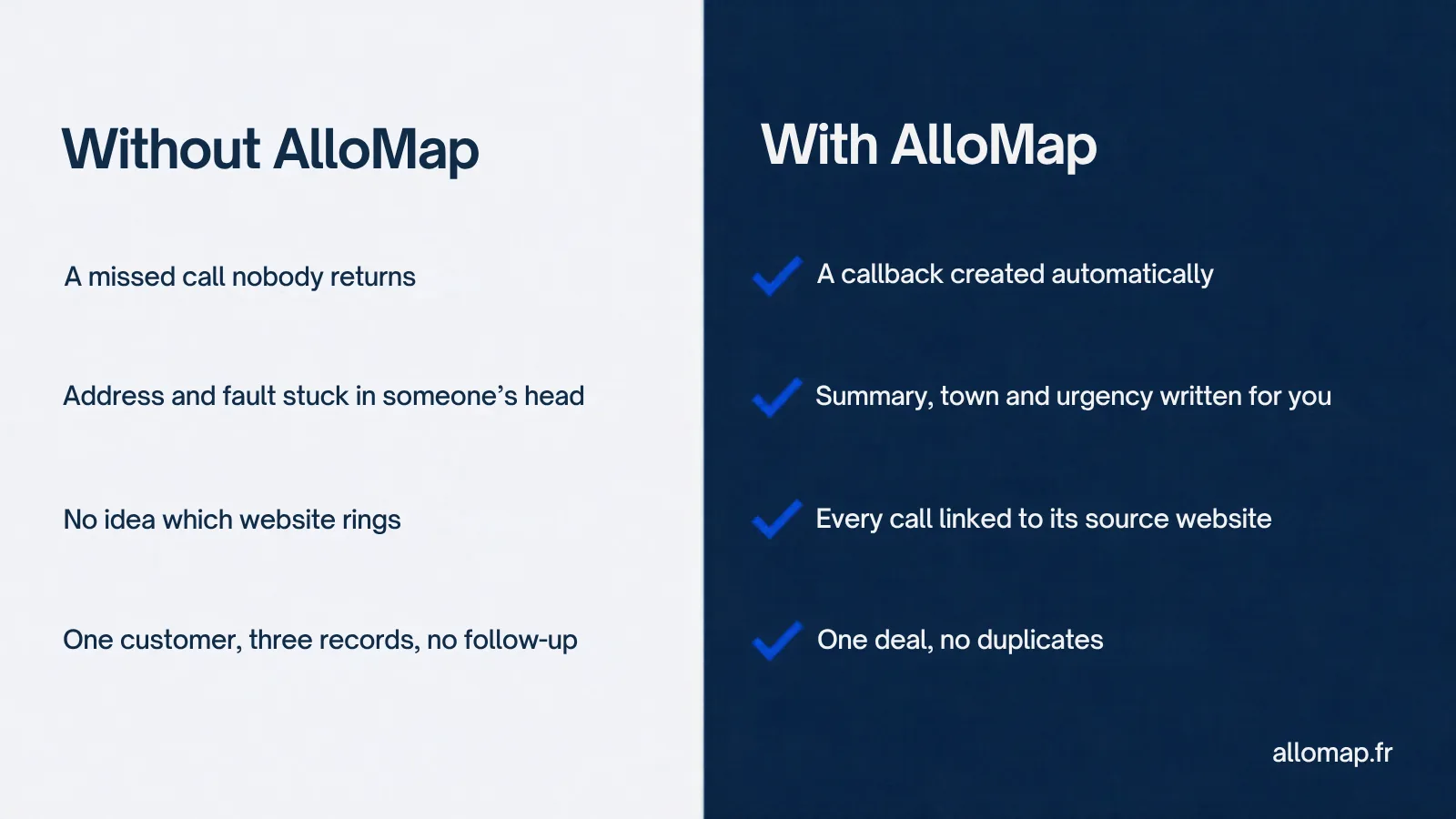
- The missed call nobody returns. On a breakdown night, an unanswered call is a customer dialling the next number.
- Information stuck in someone’s head. Address, fault code, urgency: it was all said, none of it was written down.
- The website you can’t measure. Several sites, several numbers, and no way to know which one actually makes the phone ring.
- Duplicates and forgotten follow-ups. The same customer calls three times, three records appear, and nobody calls back.
Call-centre software can solve these problems, but it is designed for switchboards, queues and agents sitting at a desk. A tradesperson answers between two jobs, in the van, hands still dirty. They have neither the time nor the patience to type anything in.
Hence AlloMap’s promise, in one line: you pick up, AlloMap takes care of the rest.
Where AlloMap comes from
AlloMap wasn’t born in a meeting room. It was born in the field, inside a repair business that takes calls every day from several websites and several phone numbers, across heating, plumbing, locksmithing and electrical work.
It started as an internal tool: record the calls, transcribe them, keep a trace. Then AI made possible what nobody had time to do by hand: read every conversation, understand what the caller wanted, and file it all in the right place.
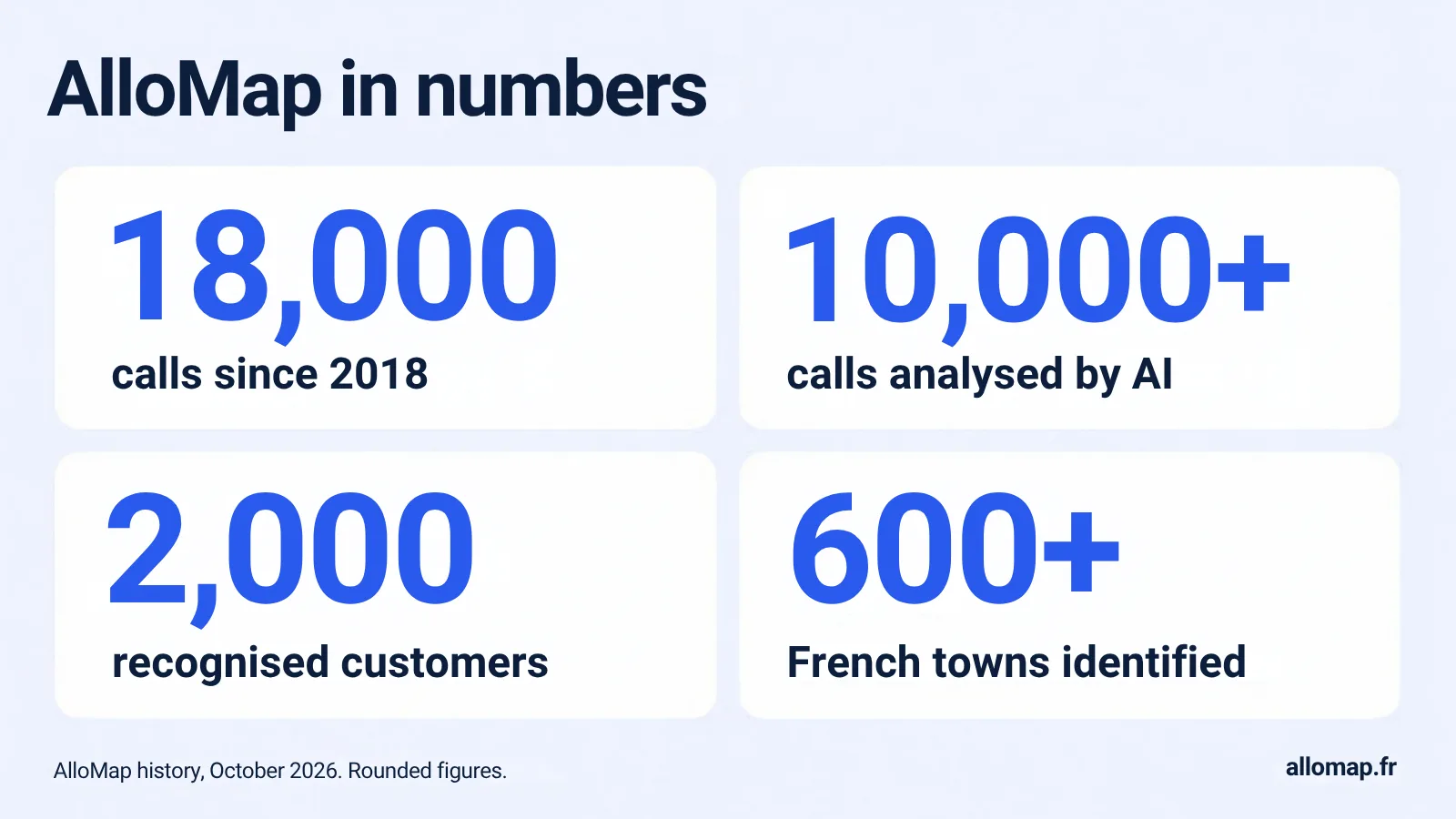
Today the history holds nearly 18,000 calls going back to 2018, more than 10,000 of them analysed by AI, 2,000 recognised customers and more than 600 French towns identified. Every screen was designed against that real-world ground.
How it works, in four steps
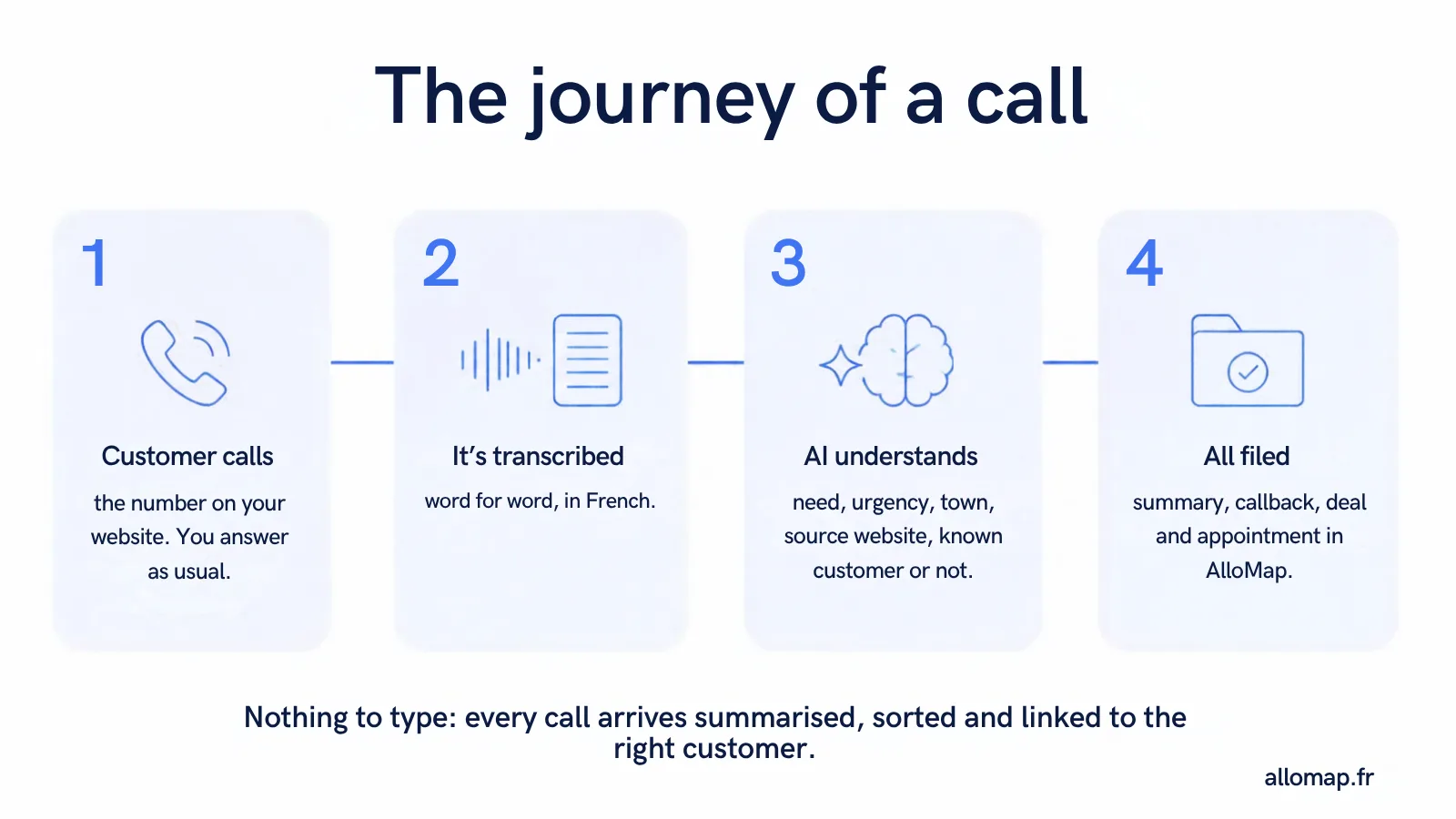
- The customer calls the number shown on your website. You answer as usual.
- The call is transcribed, word for word, in French.
- AI understands it: the need, the urgency, the town, the website it came from, and whether the caller is already known.
- Everything is filed: summary, callback, deal and appointment appear in AlloMap.
Nothing to type. Every call arrives summarised, categorised and linked to the right customer.
A day with Sophie
To tell AlloMap’s story, let’s follow Sophie Laurent, who runs a fictional repair workshop in eastern Paris. All data below is sample data: no real customer appears in this article.
8:00 am: “Today”
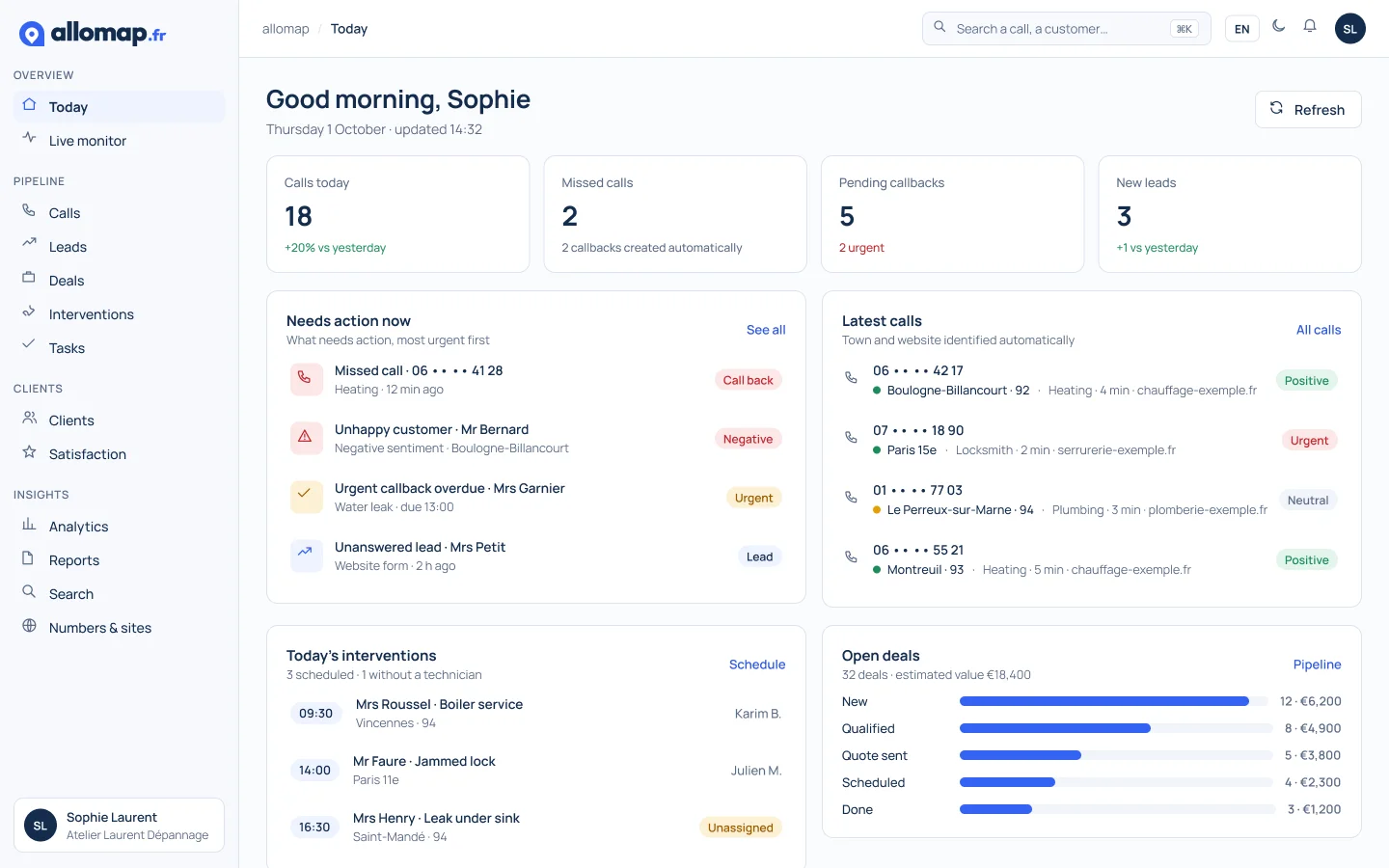
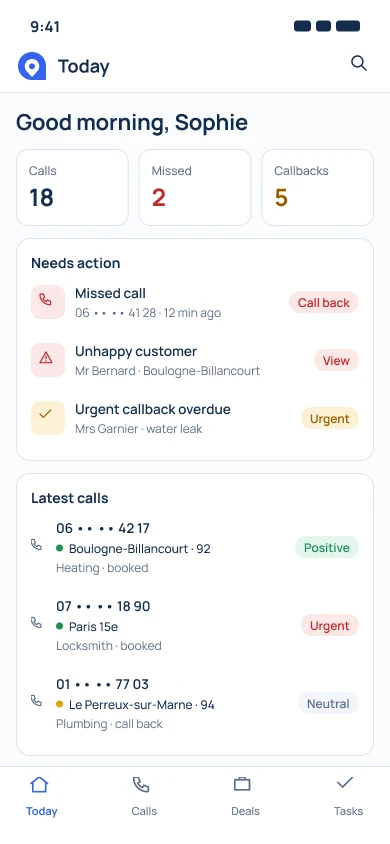
When Sophie opens AlloMap, she doesn’t land on a dashboard full of charts. She lands on Today: the day’s calls, what is waiting for a reply, and the jobs scheduled.
The “Needs action now” column is sorted from most to least urgent: a call missed twelve minutes ago, an unhappy customer, an overdue callback about a water leak. Beside it, the latest calls, each with its town and the website it came from.
That is a deliberate design choice. The owner of a repair business doesn’t want to “analyse” first thing in the morning. They want to know who to call back first.
2:18 pm: Claire’s call
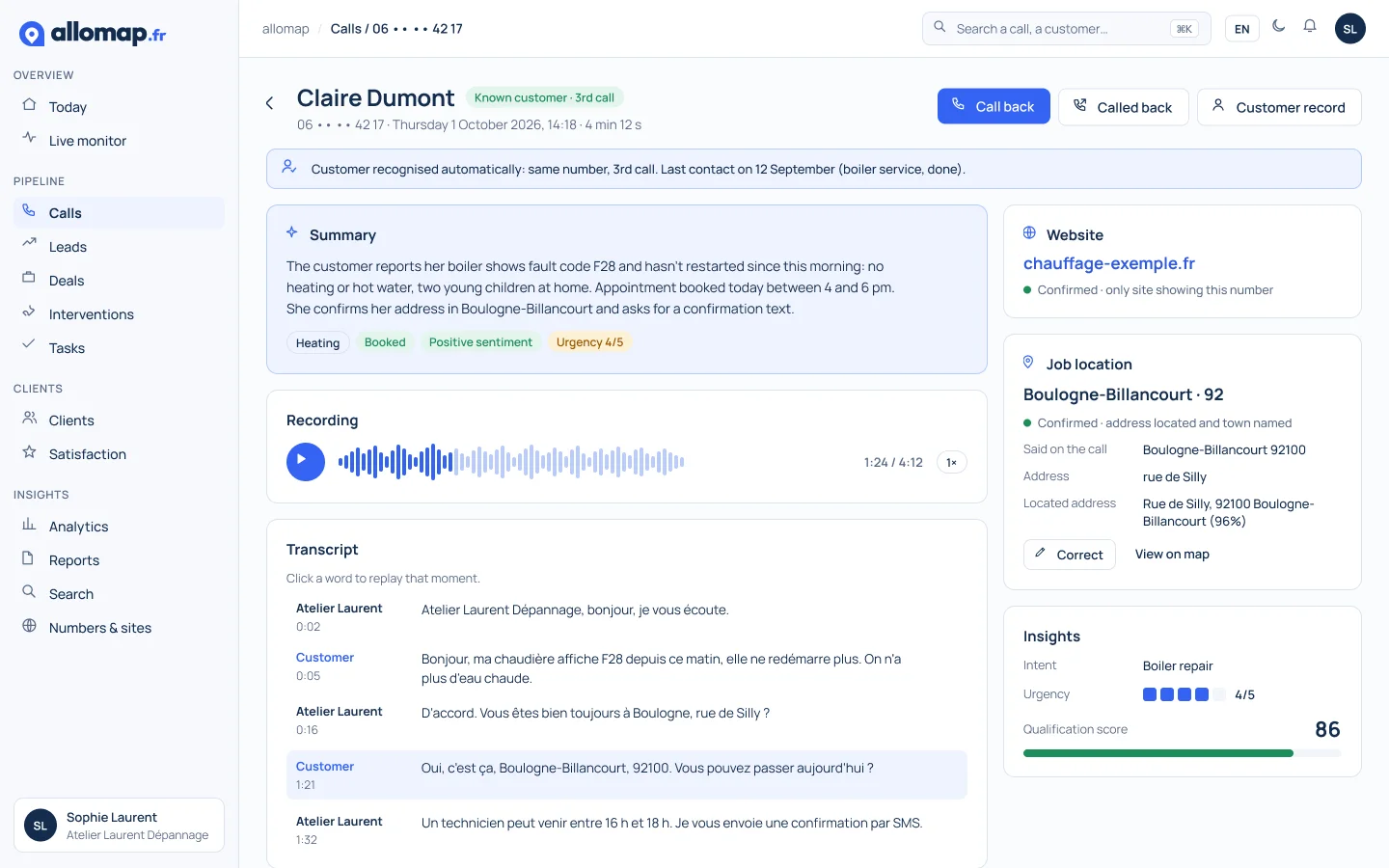
Back to Claire Dumont. In our example, she calls again in the afternoon. AlloMap recognises her straight away: same number, third call, last contact on 12 September for a boiler service.
Four minutes later, the call record is ready:
The customer reports her boiler shows fault code F28 and hasn’t restarted since this morning: no heating or hot water, two young children at home. Appointment booked today between 4 and 6 pm.
Around the summary: the trade (heating), the outcome (appointment booked), the sentiment (positive), the urgency (4 out of 5), and the source website, with its confidence level.
Below it, the full transcript. Click any word and the recording jumps to that exact moment. When a customer disputes what was said, nobody has to dig: you just listen again.
The right town, never invented
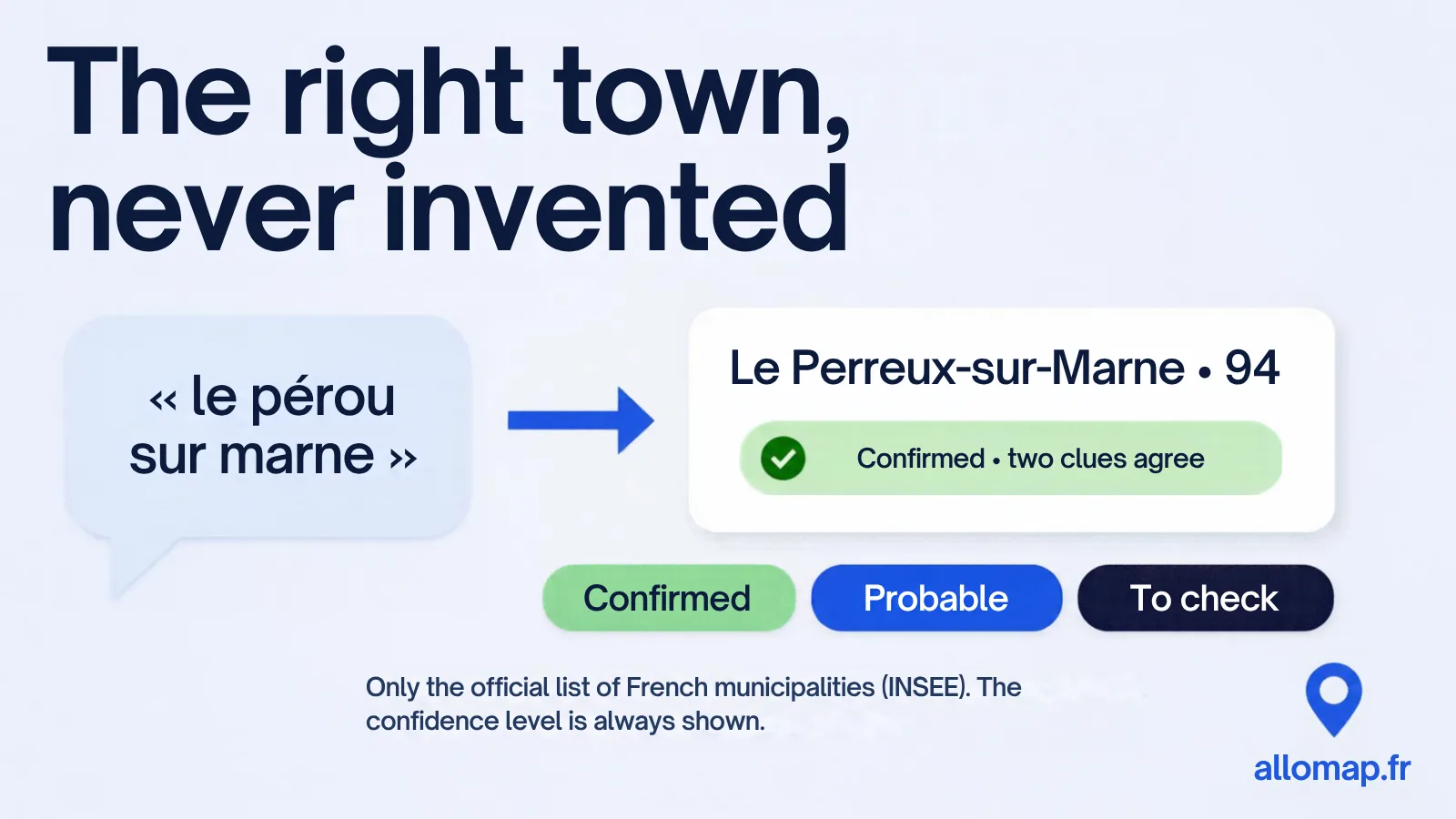
On the phone, town names get mispronounced, misheard and mistranscribed. “Le Perreux” becomes “le Pérou”, “Issy” becomes “ici”.
AlloMap doesn’t guess at random. It looks for the exact town only in the official list of French municipalities (INSEE), always shows its confidence (“Confirmed”, “Probable”, “To check”), and says so when two clues agree. A correction takes one click, and the system learns from it.
The rule is simple and non-negotiable: an invented town is worse than a missing one.
Which website makes the phone ring?
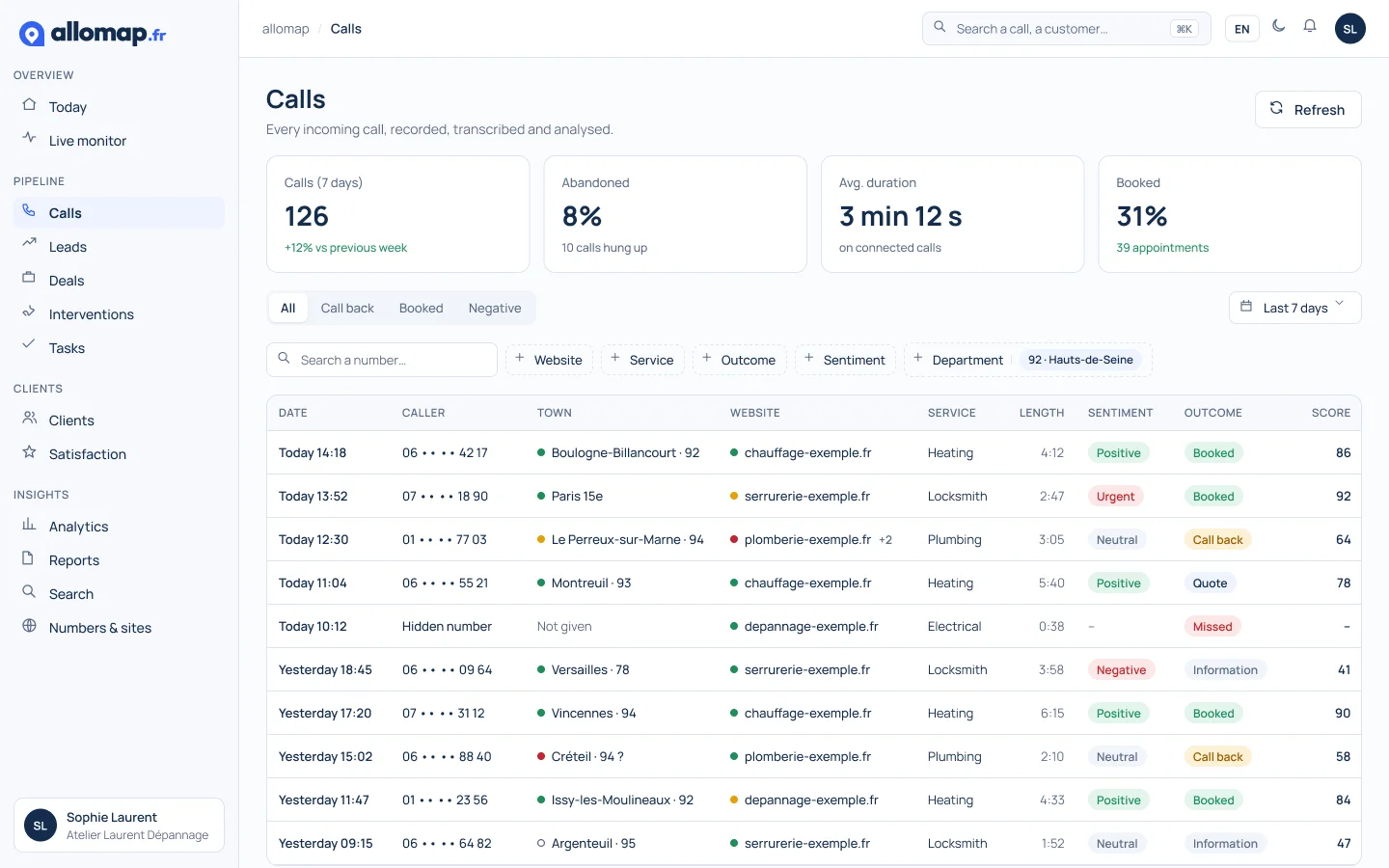
Every night, AlloMap checks your websites and the numbers they display. Every call is linked to the site it came from. If a number is shared across several sites, it flags it. If a site stops responding, an alert appears on the Today screen: its calls are about to dry up, and you’d rather know first.
Callbacks that open and close themselves
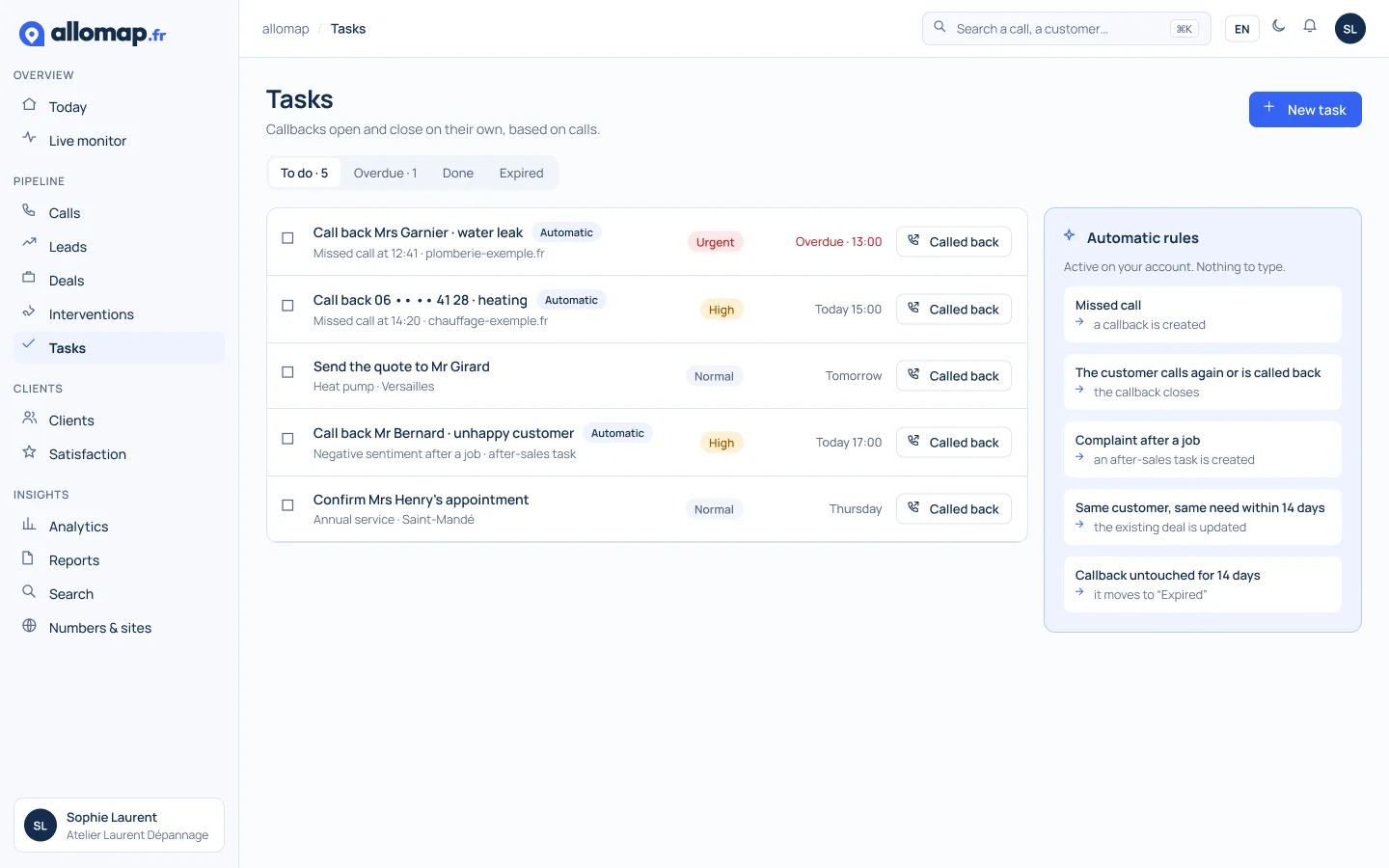
A missed call automatically becomes a callback. If the customer calls back on their own, the callback closes itself. A complaint after a job opens an after-sales task. And a “Called back” button closes a task in one tap.
The result: Sophie’s list only holds what still genuinely needs doing.
Deals without duplicates
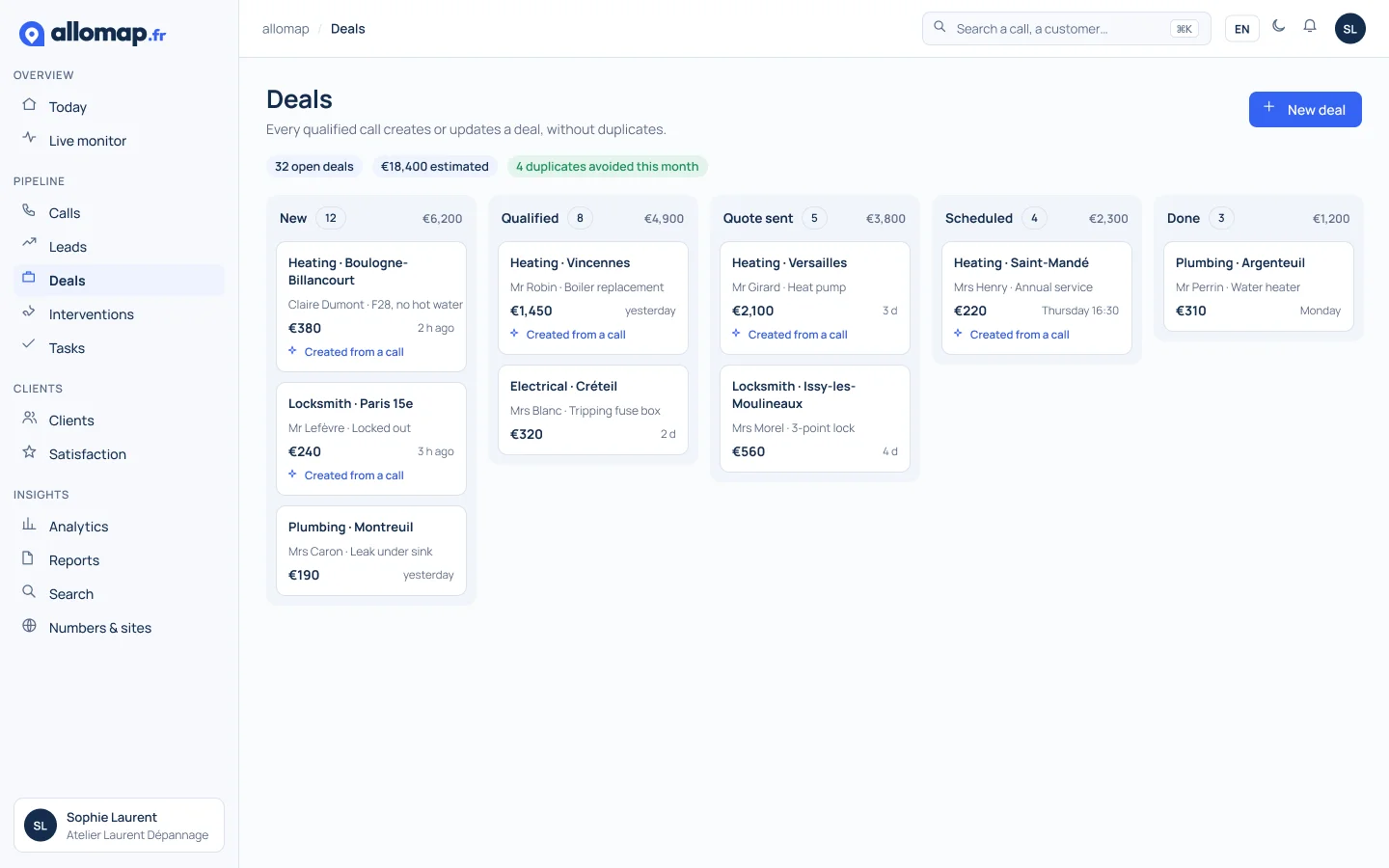
Every qualified request becomes a deal, with an estimated value. If the same customer calls again about the same need, the existing deal is updated instead of a new one being created. Deals move from “New” to “Done” by drag and drop, or through a “Move to” menu that works well with a thumb.
Schedule, search, statistics
Appointments booked on the phone land in the schedule with the customer, the town and the reason; all that’s left is to assign a technician.
Search goes through every transcript: type “water leak” and AlloMap finds the call and the exact passage, ready to replay.
Statistics finally show what works: calls per day, per trade and per website, booking rate, and the towns your customers call from.
In the van
On site, Sophie checks AlloMap on her phone: the summary and town before calling back, one tap to call, deals up to date. Each call’s summary can also arrive by email.
The design choices
Behind the screens, a few principles guided every decision.
“Today” before the dashboard. The home screen answers an action question (“who do I call back?”), not an analysis question.
Show the confidence, not just the answer. Town, website, caller identity: AlloMap always shows how sure it is. A weak match becomes a suggestion to confirm, never a certainty.
Nothing to type. Every field a tradesperson has to fill in is a field that will stay empty. AI fills it in; a human corrects it in one click.
Readable for everyone. The brand colour was adjusted after contrast testing, so text stays legible on light and dark backgrounds alike. The interface is available in French and English, in light or dark mode, on desktop and on mobile.
Police calls, always flagged. Some callers aren’t private customers: police stations, property managers, businesses. AlloMap recognises and groups them, so a call from the police never gets lost in the crowd.
Your calls stay yours
Only the people you authorise can sign in. Recordings and transcripts are available only to signed-in members of your team. The database is hosted in Frankfurt, inside the European Union.
What’s next
AlloMap keeps moving at the pace of the field. Next up: Google Business Profile tracking (coming soon). A dedicated number per listing, so you know what each one brings in, and a same-day alert if a listing disappears from Google Maps or its number changes.
Ready to stop losing calls?
AlloMap adapts to your websites, your numbers and the way you work. Each site shows its own tracking number, so you know where every call comes from, what it asks for, and what it turns into.
All data visible in the screenshots is sample data.